You rolled out of bed this morning and felt it immediately. That familiar tightness across your lower back. Maybe it loosens up after a few minutes of moving around. Maybe it doesn't. Either way, you've probably started to think of it as just part of your day, something you manage rather than something you fix.
Here's what most people don't realize: low back stiffness is rarely just a low back problem.
When your lumbar spine loses its normal range of motion, your body doesn't stop moving. It finds other ways to get the job done. Your hips pick up the slack. Your upper back compensates. Over time, these workarounds become your new normal, and that's when things start breaking down in places you never expected.
Understanding why your spine stopped moving in the first place is the first step toward getting your whole body working the way it should again.
What "Low Back Stiffness" Actually Means
Most people describe low back stiffness as a sensation of tightness or restriction, usually worst first thing in the morning or after sitting for a long time. It often eases up with movement, which is why a lot of people assume they just need to stretch more or walk it off.
But stiffness in the lumbar spine is not simply tight muscles. It often reflects a loss of mobility at specific spinal segments, meaning individual vertebrae are not moving through their full range of motion. When one or more segments become restricted, the segments above and below are forced to compensate by moving more than they should.
Think of it like a chain with one stiff link. Every other link has to work harder to make up the difference.
Over time, those overworked segments become irritated and painful, and now you have a problem that started in one place but has spread to several others. This is one of the most common reasons people feel like their back pain keeps moving around or "comes back" in slightly different spots.
Why the Spine Loses Mobility in the First Place
The lumbar spine is built to move in multiple directions, including flexion, extension, rotation, and side bending. Healthy movement requires a combination of mobile joints, well-functioning muscles, and a nervous system that feels safe letting those movements happen.
When any one of those pieces breaks down, restriction follows. Here are the most common reasons it happens.
Prolonged sitting is probably the biggest contributor for most active adults. When you sit for extended periods, the hip flexors shorten, the glutes stop activating properly, and the muscles along the lumbar spine adapt to a flexed, compressed position. Over time, your spine starts to expect that position and resists movement out of it.
Previous injury plays a major role as well. Even minor strains that "healed" often leave behind protective muscle guarding that never fully resolves. Your nervous system learned that a certain movement was dangerous and has been quietly limiting that range ever since, even when the original injury is long gone.
Lack of full-range movement in daily life is another factor that often gets overlooked. If you spend most of your day in a relatively narrow range of motion, your spine loses confidence outside that range. The joints stiffen, the surrounding soft tissue tightens, and the whole system becomes less responsive.
The Hip Compensation Problem
This is where things get interesting for active people, because the hip and lumbar spine are deeply connected in terms of how your body distributes movement.
There is a principle in movement assessment called lumbopelvic rhythm. In simple terms, it describes how your low back and hips are supposed to share the workload when you bend, lift, rotate, or load your body. When the lumbar spine is stiff and not contributing its fair share of motion, the hips are forced to compensate.
At first, this compensation works. You can still run, squat, lift, and swing a club without too much trouble. But compensatory movement patterns have a cost. The hip joint is not designed to carry the full burden of movement that should be shared with the lumbar spine. Over time, the soft tissue around the hip becomes overloaded. The glutes, hip flexors, and hip rotators are working overtime. Labral irritation, hip flexor strains, and SI joint problems are some of the most common downstream consequences of a chronically stiff lumbar spine.
Many people who come in with hip pain are surprised to find out that the primary issue is in their low back, not their hip at all.
What This Means for Your Active Lifestyle
If you run, cycle, golf, lift weights, or play any kind of sport, low back stiffness matters more than you might think.
Running with reduced lumbar mobility puts extra demand on the hip extensors and creates a shortened stride length over time. Cyclists often develop anterior hip tightness that is made significantly worse by a stiff lumbar spine that cannot properly extend. Golfers lose rotational range of motion at the lumbar level and often try to make up for it at the thoracic spine or the hip, which creates a completely different set of problems.
The pattern is the same across all of these activities. Your body finds a way to keep moving, but the workaround has consequences that compound over months and years.
The Whole-Body Connection
What makes lumbar stiffness such a tricky problem is that it does not stay local. When the lumbar spine is restricted, the effects ripple outward in both directions.
Below the lumbar spine, the hips and SI joint are affected in the ways we just discussed. But the effects travel upward as well. The thoracic spine, which is the mid-back, often becomes hypermobile as it tries to compensate for the lumbar restriction. This can lead to mid-back pain, tightness between the shoulder blades, and even neck tension that seems completely unrelated to the original problem.
This is exactly why treating low back stiffness in isolation rarely works. Addressing just the lumbar spine without looking at what the hips and thoracic spine have been doing to compensate usually leads to temporary improvement followed by the same pattern coming back.
A comprehensive movement assessment looks at the full picture, examining how the lumbar spine, hips, pelvis, and thoracic spine are all working together and identifying where the breakdowns are actually occurring, not just where the pain is showing up.
What Actually Helps
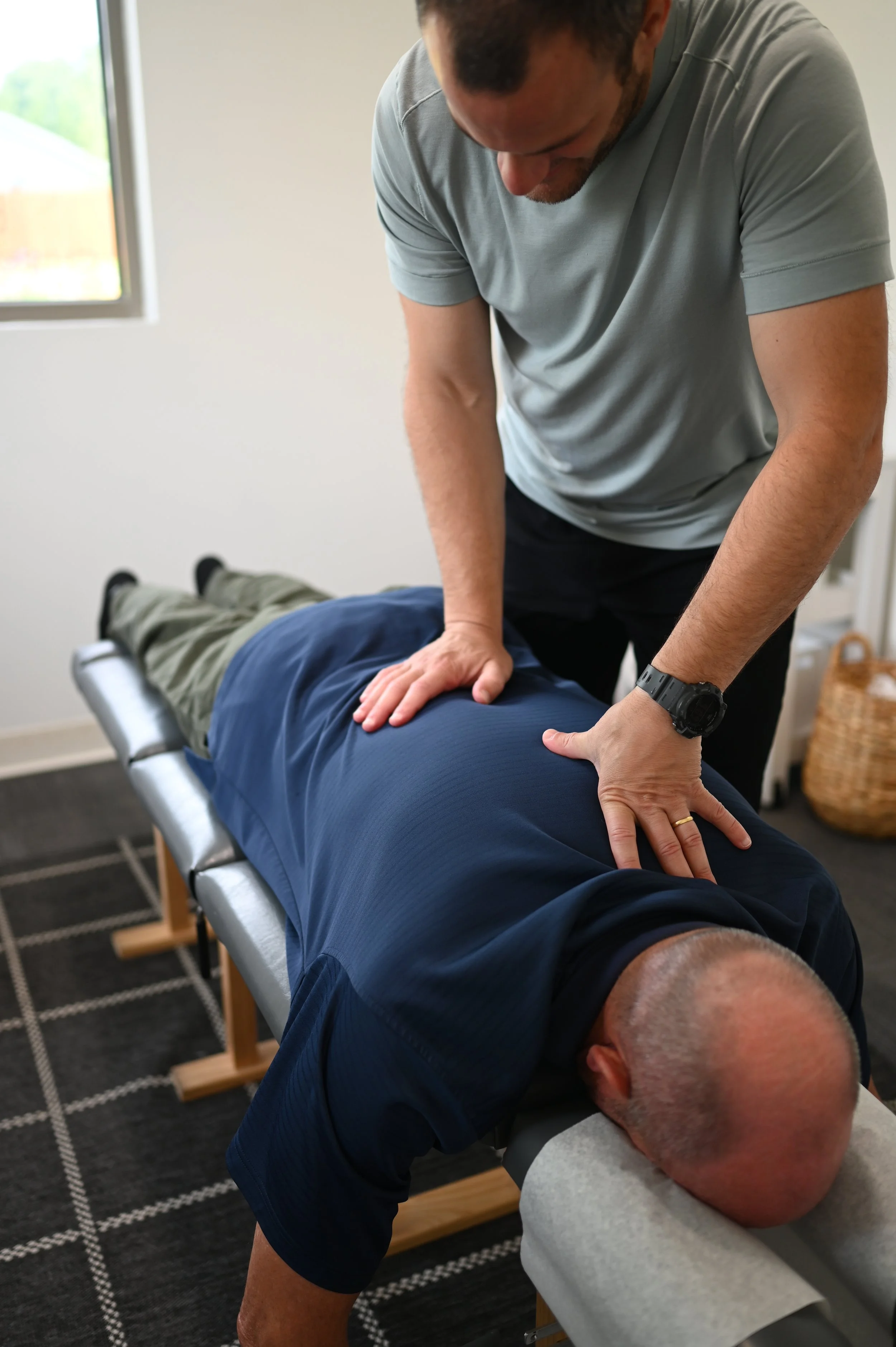
Restoring lumbar mobility is not about aggressive stretching or cracking your own back against a foam roller. It starts with identifying which segments are restricted and why, and then applying targeted movement and manual therapy to restore normal motion at those specific levels.
Once the lumbar spine is moving more freely, the compensation patterns that developed in the hips and thoracic spine need to be addressed as well. This usually involves both hands-on care and guided movement work to retrain the body to distribute load the way it was designed to.
The goal is not just to reduce pain. The goal is to restore the movement capacity your body needs to keep doing the things you care about, without constantly managing symptoms.
If your low back stiffness has been something you live with rather than something you have addressed at the root cause, it is worth getting a thorough assessment. Understanding exactly what is restricted, what is compensating, and why the pattern developed in the first place gives you a clear path forward rather than another round of temporary relief.
Ready to stop managing and start moving? Book a movement assessment at Balanced Chiropractic and Wellness and find out what your low back stiffness is really telling you.
If you want to go deeper on how the lumbar spine and hips are designed to share movement, this overview of lumbopelvic rhythm breaks it down clearly.