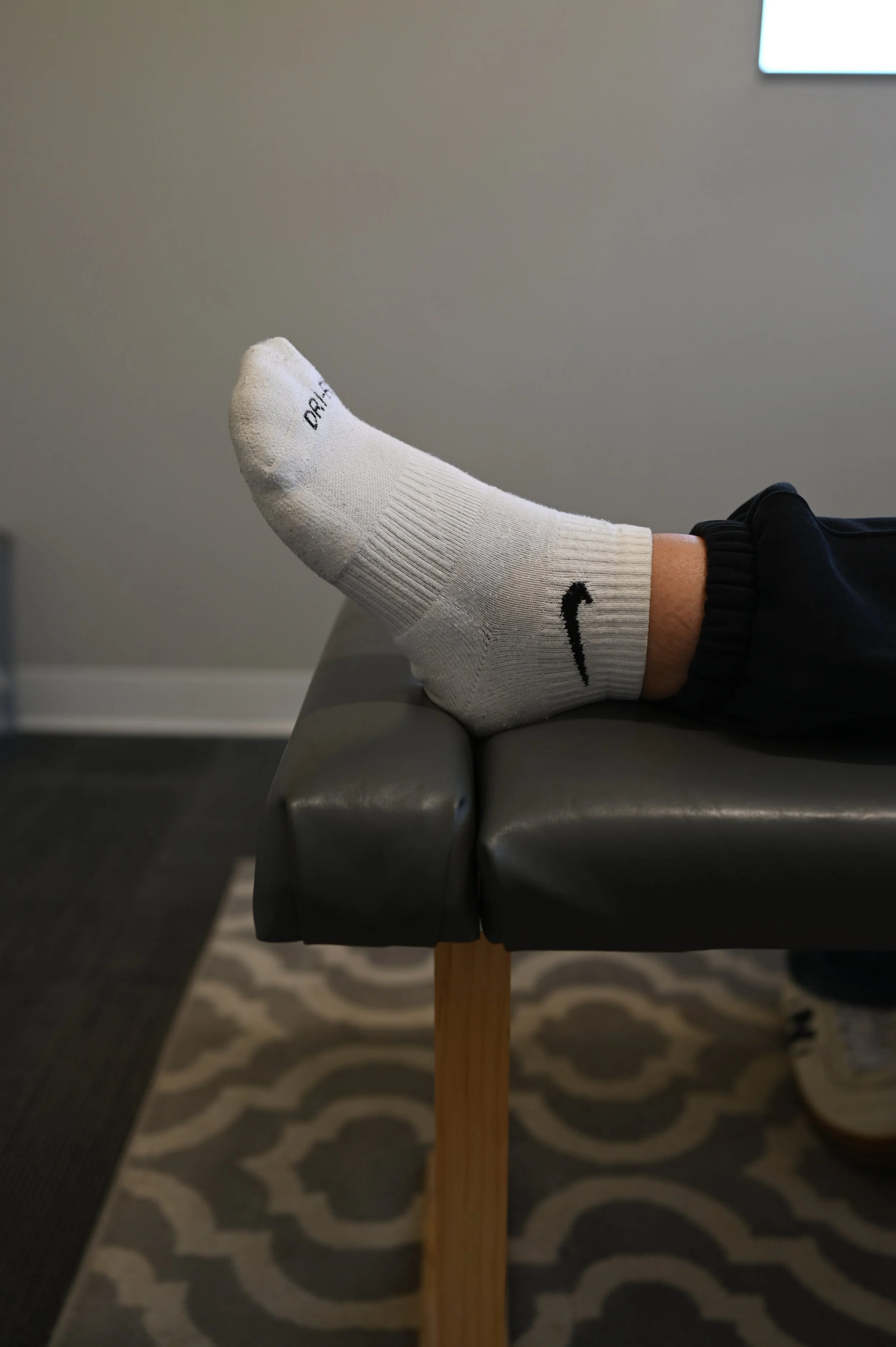
You probably don't spend much time thinking about your big toe. It's just there, doing its thing, mostly ignored until something goes wrong. But here's the truth: your big toe is one of the most important joints in your entire body for movement, and when it stops working the way it should, the effects travel up your leg, into your hip, and straight to your low back.
If you've been dealing with nagging foot pain, knee discomfort, hip tightness, or unexplained back problems here in the Madison area, your big toe may be playing a bigger role than anyone has bothered to explain to you.
What Your Big Toe Actually Does
Every time you take a step, your body goes through a sequence. Your heel strikes the ground, your foot rolls forward, and then, right at the end of that sequence, your big toe has to bend upward to allow your body to push off and move forward. That motion, called dorsiflexion of the first toe, has to happen, and it has to happen with enough range of motion, or your whole movement system starts to compensate.

The big toe needs roughly 65 degrees of upward bend to allow a normal walking gait. For running, the demand is even higher. When you don't have that range, your body doesn't stop and send you an error message. It just finds another way to get through the movement, and that workaround is where the problems begin.
When the Big Toe Doesn't Move Well
A stiff or limited big toe joint is called hallux limitus, and in more severe cases, hallux rigidus. But even before it reaches a clinical diagnosis, reduced motion in that joint changes how you move in ways that most people never connect back to the toe itself.
Here is what commonly happens. When your big toe can't bend enough to allow a proper push off, your foot compensates by rolling inward, a motion called pronation. That inward roll changes the alignment of your ankle and then your knee. Your knee starts to track differently, which shifts load into your hip. Your hip then has to work harder to stabilize, and when the hip gets overloaded, the muscles around your low back pick up the slack.
This is a chain reaction, and your toe started it. But because the pain shows up in your back or your knee, that's where most people focus their treatment. The source of the problem goes unaddressed, and the pattern keeps repeating. We see this regularly in patients coming to us from Madison, Windsor, DeForest, and the surrounding communities, and it's one of the most commonly missed connections in foot and lower body care.
Why This Connects to Foot Arch Problems
Your big toe also plays a central role in something called the windlass mechanism. When the big toe bends upward during walking, it tightens the plantar fascia, the band of tissue running along the bottom of your foot, which raises the arch and creates a rigid lever for push off. This is your foot's built in mechanical system for transferring force efficiently.
When big toe mobility is limited, the windlass mechanism doesn't engage properly. The arch loses its ability to stiffen at the right moment. The foot becomes less efficient as a lever, meaning your muscles have to work harder to do the same job. Over time that leads to fatigue, pain, and the kind of movement compensation that shows up as problems elsewhere in the body.
If you've been dealing with plantar fascia pain, flat feet, or an arch that seems to collapse when you run or stand for long periods, big toe function is something that deserves a close look.
The Running and Sport Connection
Greater Madison is full of active people. Whether you're logging miles on the paths around Lake Monona, playing in a recreational league, hitting the trails near DeForest, or grinding through workouts at a local CrossFit gym, your big toe is working hard every single time you move.
During running, the forces going through your foot are multiple times your body weight. The system needs to handle those forces efficiently. Restricted big toe extension during running forces the foot to compensate through early heel rise, which loads the calf and Achilles tendon more than normal. It changes how your knee tracks through the stride cycle. It limits your ability to generate power off the ground. Runners and athletes with limited big toe mobility often develop Achilles tendinopathy, calf strains, shin splints, and stress fractures, and none of those issues typically get traced back to the toe during treatment.
The same applies to lateral movements in court sports, the hip hinge pattern in deadlifts and squats, or the follow through in a golf swing at one of the courses around the Windsor or Sun Prairie area. Big toe mobility shows up across all of it.
What Causes Big Toe Mobility to Decline
Several things contribute to a stiff or limited big toe joint. Repetitive stress over time can cause wear and bone spur formation around the joint, which physically limits how far it can bend. Old injuries, even minor ones that seemed to heal fine, can leave behind scar tissue that restricts motion. Poor footwear, particularly shoes with a narrow toe box or a stiff sole, limits the natural movement the joint needs over thousands of steps per day. And muscle tightness and movement dysfunction in the foot itself can restrict the joint even when the joint structure is otherwise healthy.
In many cases, the restriction isn't coming from damage inside the joint at all. It's coming from how the surrounding tissues are loading and moving, which means it responds very well to hands on care and movement work.
Assessing the Whole System
At Balanced Chiropractic and Wellness, when someone comes in dealing with foot pain, knee issues, or low back problems, looking at big toe mobility is part of the full movement assessment, not an afterthought. The first question isn't just where does it hurt, it's where is the movement system breaking down, and how far up the chain has that breakdown traveled.
A thorough assessment looks at how the big toe moves in isolation and how it functions during walking and dynamic movement. It looks at how the foot, ankle, knee, and hip are compensating. It connects the dots between what the toe is doing and what's happening two or three joints away.
That's the difference between treating a symptom and actually solving the problem. It's an approach we've built our practice around, and it's why patients from Madison, DeForest, Windsor, and Dane County regularly find their way to us after trying other options that only addressed part of the picture.
What You Can Do
If you're dealing with any of the issues described here, the first step is finding out whether big toe mobility is actually part of your pattern. Not everyone with back pain has a toe problem. But enough people do that it's worth including in a thorough evaluation.
Improving big toe mobility and retraining how the foot loads during movement can have significant effects on pain and function further up the chain. Patients who come in for knee or hip complaints are sometimes surprised to learn that working on foot mechanics makes a meaningful difference. That's not a magic trick. It's just how the system works.
If you're in the Madison, Windsor, DeForest, or broader Dane County area and want to understand how your movement patterns are connected, reach out to Balanced Chiropractic and Wellness to schedule a full movement assessment. Understanding what's actually driving your symptoms is the first step toward fixing it for good.