If you've been dealing with shin splints for more than a couple of weeks, you already know the routine. Ice it. Rest it. Wait for it to feel better. Then go back to running and have it come right back.
That cycle is frustrating, and it makes sense that you'd start wondering whether there's something else going on that nobody has actually looked at yet.
The short answer is yes, chiropractic care can absolutely help with shin splints. But the more important answer is that it depends entirely on finding out why your shins are getting overloaded in the first place. That's the piece most people never get.
What Are Shin Splints?
Shin splints is the common name for medial tibial stress syndrome, which is pain along the inside edge of your shin bone. If you've got it, you know exactly what it feels like. That deep, achy soreness that shows up when you start your run, sometimes eases up after you warm up, then comes back hard after you stop. Or it just hurts the whole time you're moving.
Either way, it's keeping you from doing what you want to do.
If you're training for the Madison Marathon, putting in miles on the Capital City Trail, or just trying to stay consistent with your running around Windsor or DeForest, shin splints aren't just a minor inconvenience. They're a real threat to your training and your routine.
Why Are Your Shins Actually Hurting?
Here's where most treatment approaches get it wrong. They focus entirely on the shins themselves. Rest, ice, maybe some new shoes or an insert. Those things might take the edge off temporarily. But if you don't address why the shins are getting stressed in the first place, you're just managing symptoms until the next flare up.
So what's actually causing the overload?
Your ankle mobility might be limited. Every time you take a step, your ankle needs to move through a decent range of motion. Dorsiflexion specifically, which is pulling your toes up toward your shin, has to happen smoothly for your leg to absorb force correctly. When that ankle motion is restricted, the muscles running along your shin have to compensate and pick up the slack. Step after step, mile after mile, they get worn down.
Your hip might not be stabilizing properly. When your glutes aren't doing their job during running, your whole leg has to compensate. Your knee might drift inward slightly. Your foot might pronate more than it should. Those small compensations create abnormal forces that travel all the way down to your shin and the tissues around it.
Your calves might be too tight or too weak. Tight calves directly restrict ankle mobility, which creates the problem described above. Weak calves can't absorb ground impact properly, so more of that load gets shifted to your shins. Either way, your shins end up doing more than they should.
You might have ramped up too fast. Your cardiovascular fitness can improve quickly. Your bones, tendons, and connective tissue adapt much more slowly. If you jumped from casual runs to bigger mileage, switched from a treadmill to pavement in Madison's parks, or started adding hills, your shins may simply not have had enough time to catch up.
Your foot mechanics might be contributing. If your arch collapses too much when you run, or if your foot isn't pushing off efficiently, the muscles along your shin have to work harder to control what your foot is doing. Thousands of steps later, that extra demand shows up as pain.
Why Did This Pattern Start?
This is usually the part nobody has explained to you.
A lot of people dealing with shin splints have an old ankle sprain somewhere in their history. It healed. They moved on. But the joint never fully regained its normal range of motion, and the body built compensations around it. For years that was fine. Then running mileage went up and those old compensations started causing problems.
A lot of people also spend most of their day at a desk. If you're working in Madison or out at Epic in Verona and sitting for long stretches, your hips tighten up and your glutes stop firing as efficiently as they should. When you go for an evening run around Windsor or DeForest, your body doesn't move the way it needs to, and your shins take the hit.
Neither of those things means something is permanently wrong with you. It just means there are patterns in how your body moves that need to be addressed, not just rested.
How We Help at Balanced Chiropractic + Wellness
You were made to move. That includes running without shin pain.
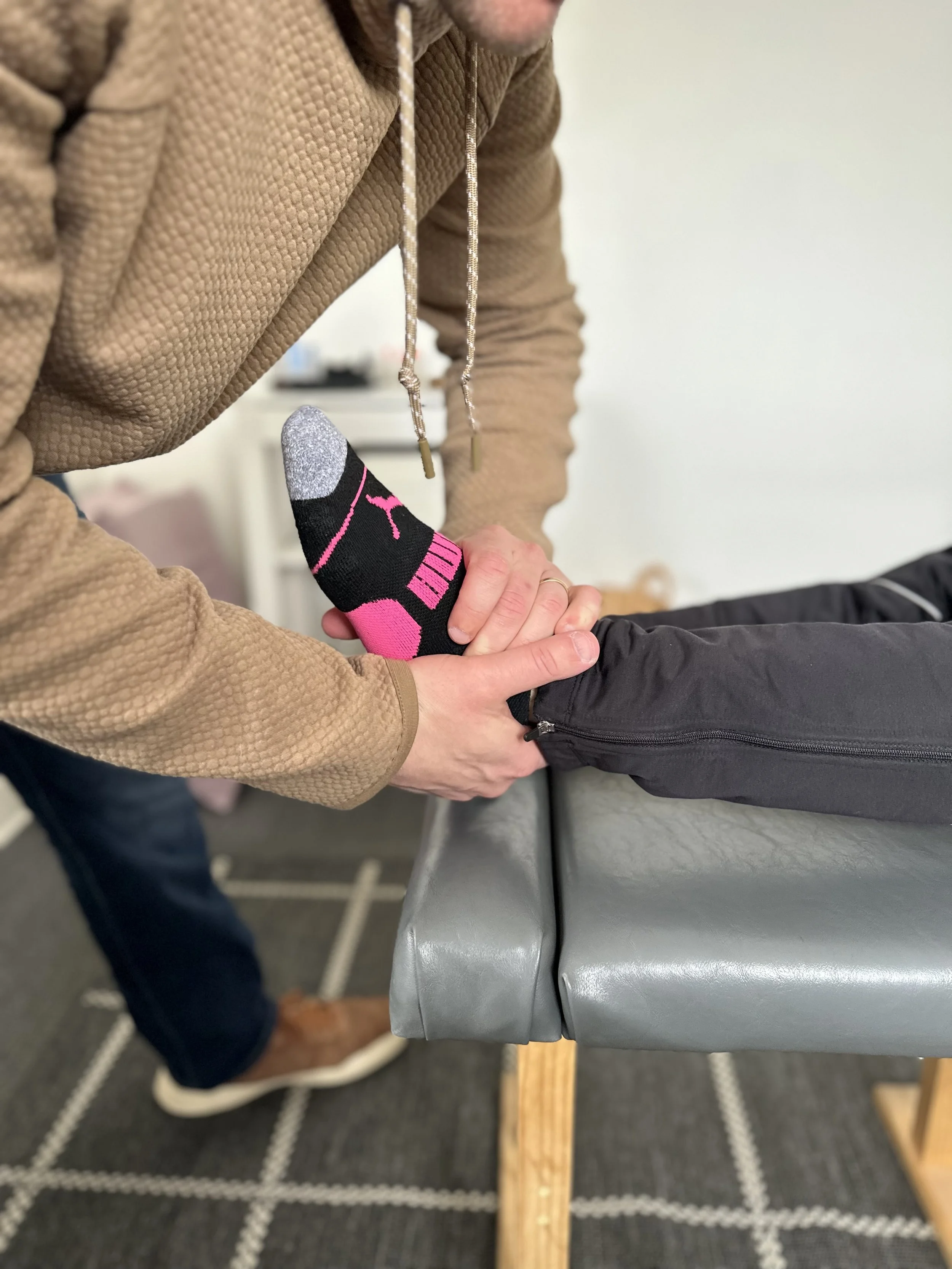
When someone comes into our office in Windsor with shin splints, we don't just look at the shins. We assess the whole system. Using the Selective Functional Movement Assessment, we look at ankle mobility, hip stability, foot mechanics, calf function, pelvic position, and spinal movement. We're trying to find the restrictions and imbalances that are forcing your shins to overwork every time you run.
From there, we use specific chiropractic adjustments to restore proper movement to the ankle, foot, hip, and pelvis. When your ankle moves the way it's supposed to, your shin muscles don't have to compensate. When your hip stabilizes correctly, the abnormal forces that were traveling down to your shin stop happening.
We also use soft tissue work to address tight calves and release adhesions in the shin muscles themselves. Depending on what your body needs, that might include IASTM, cupping, or dry needling.
And we give you specific exercises to retrain the movement patterns that caused the overload. Ankle mobility drills. Hip stability work. Calf strengthening. Foot exercises. The goal is to fix the pattern, not just quiet down the symptoms.
We'll also help you think through your training structure. How to manage your mileage while you're healing. What surfaces make sense to prioritize. Whether cross training is a good option for you while things calm down.
What You Can Do on Your Own
A few things can help you manage this while we work on the underlying pattern together.
Check your ankle mobility right now. Stand about four inches from a wall, toes pointing forward. Try to touch your knee to the wall without your heel coming up. If you can't do it, limited dorsiflexion is almost certainly contributing to your shin splints. Work on that stretch daily.
Roll your calves, not just your shins. Most people focus on massaging the shin area, which can help a little. But your calves are usually the bigger culprit. Spend real time with a foam roller on your calves, including both the gastrocnemius along the back and the deeper soleus lower down.
Work on your hips. Glute bridges, clamshells, and single leg exercises go a long way toward improving the hip stability that takes stress off your shins when you run.
Back off your volume temporarily. A 30 to 50 percent mileage reduction while you address the underlying issues is worth it. Swimming or cycling can keep your fitness up without loading your shins.
Ice after activity if there's swelling or heat. If your shins feel hot and inflamed after you run, ice can help in the short term. But if you've been dealing with this for weeks, inflammation is not the main issue. Mechanics are.
Don't push through worsening pain. Shin splints can progress to stress fractures. If the pain is sharp, if it's showing up when you're not running, or if it's getting worse rather than better, you need to get it evaluated.
The Bigger Picture
If you've been told to just stop running, that's not the answer we offer. The goal is to find out what's driving the overload, fix those patterns, and get you back to training without constantly managing pain.
Runners in Madison, Windsor, Sun Prairie, DeForest, and across Dane County don't have to accept shin splints as part of the deal. This is a solvable problem when you actually look at the root cause.
Book a comprehensive movement assessment at Balanced Chiropractic + Wellness in Windsor. Let's figure out what's actually going on and get you back to running without limitations.