Why Does My Hip Pinch When I Squat And What Can Actually Fix It?
You bend down to pick something up and feel it that deep, catching pinch at the front of your hip. You try to squat at Windsor Athletic Club or get out of your car after a long commute and that familiar ache reminds you something isn't right. You've tried stretching. You've been told to strengthen your glutes. Maybe someone even suggested you "just can't squat deep it's your anatomy."
If you're dealing with hip pain during squatting or everyday movements in the Madison, Windsor, or DeForest area, you're not alone and you're not stuck. Let's talk about what's actually going on.
What You're Feeling (And Why It's More Than Just "Tight Hips")
That deep, pinching sensation when you squat, tie your shoes, or step out of your car after your commute has a name: hip impingement, also called femoroacetabular impingement or FAI. It happens when your femur (thigh bone) and hip socket make contact in a way they shouldn't during movement.
But here's where most people get stuck they treat the hip like it's the whole problem.
It usually isn't.
The Advice You've Probably Already Tried
"Stretch your hip flexors." "Strengthen your glutes." "Try yoga." Sound familiar? These aren't bad suggestions, but if they haven't fixed the pinching sensation, it's because they're addressing symptoms not the reason your hip is impinging in the first place.
Flexibility and strength matter. But hip impingement isn't usually a flexibility problem or a strength problem. It's a positioning and movement problem.
The Root Cause Why Your Hip Is Actually Impinging
I say this to patients all the time: problems in the body arise from too much movement, not enough movement, or not enough variety in movement. Hip impingement is almost always a "not enough movement in the right places" situation.
Your hip is a ball-and-socket joint designed to move in every direction forward, back, rotation, side to side. For it to do that smoothly, a whole chain of things above and below it need to be working properly. When they're not, your hip compensates. That compensation is what creates the abnormal bone contact you feel as a pinch.
Here's what's typically driving it:
Your Pelvis Isn't in Neutral
If your pelvis is tilted forward (anterior pelvic tilt) or rotated which happens a lot when you sit for 8-10 hours a day the orientation of your hip socket changes relative to your femur. So when you try to squat or bring your knee toward your chest, the bones jam together instead of gliding. Think of it like a door that's hung crooked on its hinges. You can force it open, but it's going to catch every time.
Your Low Back Has Stopped Moving
When you squat, your lumbar spine should flex slightly. If it's stiff from years of desk work or old injuries, your hip has to pick up the slack and flex more than it's designed to. More hip flexion than the joint is built to handle equals impingement.
Your Hip Is Missing Internal Rotation
As you squat, your hip needs to rotate internally. If you've lost that rotation or if your hip has developed an external rotation bias from sitting the geometry of the joint changes. The bones don't line up the way they should. Pinching happens.
You Sit. A Lot.
If you're commuting to Epic and working at a desk all day, your hips are in a flexed position for hours straight. Your hip flexors adaptively shorten. Your posterior hip capsule tightens. Your pelvis tilts forward. That's a perfect storm for hip impingement, and it develops gradually which is why many people don't notice it until they increase their activity level or start going deeper in their squats.
Why Your Body Developed This Pattern in the First Place
Your body didn't randomly decide to make squatting painful. This pattern developed because of how you've been moving or not moving over time.
Maybe you had a low back issue years ago, and your lumbar spine quietly stopped moving as well. Your hip has been compensating for it ever since. Maybe you ramped up your training at Burn Bootcamp or started adding more volume to your workouts, and the demands on your hip finally exceeded what your compensated movement pattern could handle.
Your body adapted. Those adaptations worked until they didn't.
The good news is that adaptations can be changed. Your movement patterns aren't permanent. They just need the right approach.

How We Address Hip Impingement at Balanced Chiropractic + Wellness
When someone comes to us with hip pain during squatting or daily movements, we're not handing them a generic hip flexor stretch and calling it a day. We do a comprehensive assessment of how your entire lower body and pelvis is functioning together.
We're looking at pelvic alignment and position. Lumbar spine mobility. Hip joint mechanics, specifically internal rotation and the balance between the front and back structures of the joint. Foot and ankle function because yes, limited ankle mobility can travel up the chain and show up as hip impingement.
Chiropractic Adjustments to Restore Alignment
Through specific chiropractic adjustments, we restore proper alignment to the pelvis and lumbar spine. When your pelvis is sitting in a neutral position, your hip socket is oriented the way it should be. When your low back moves properly, your hip doesn't have to compensate with excessive motion.
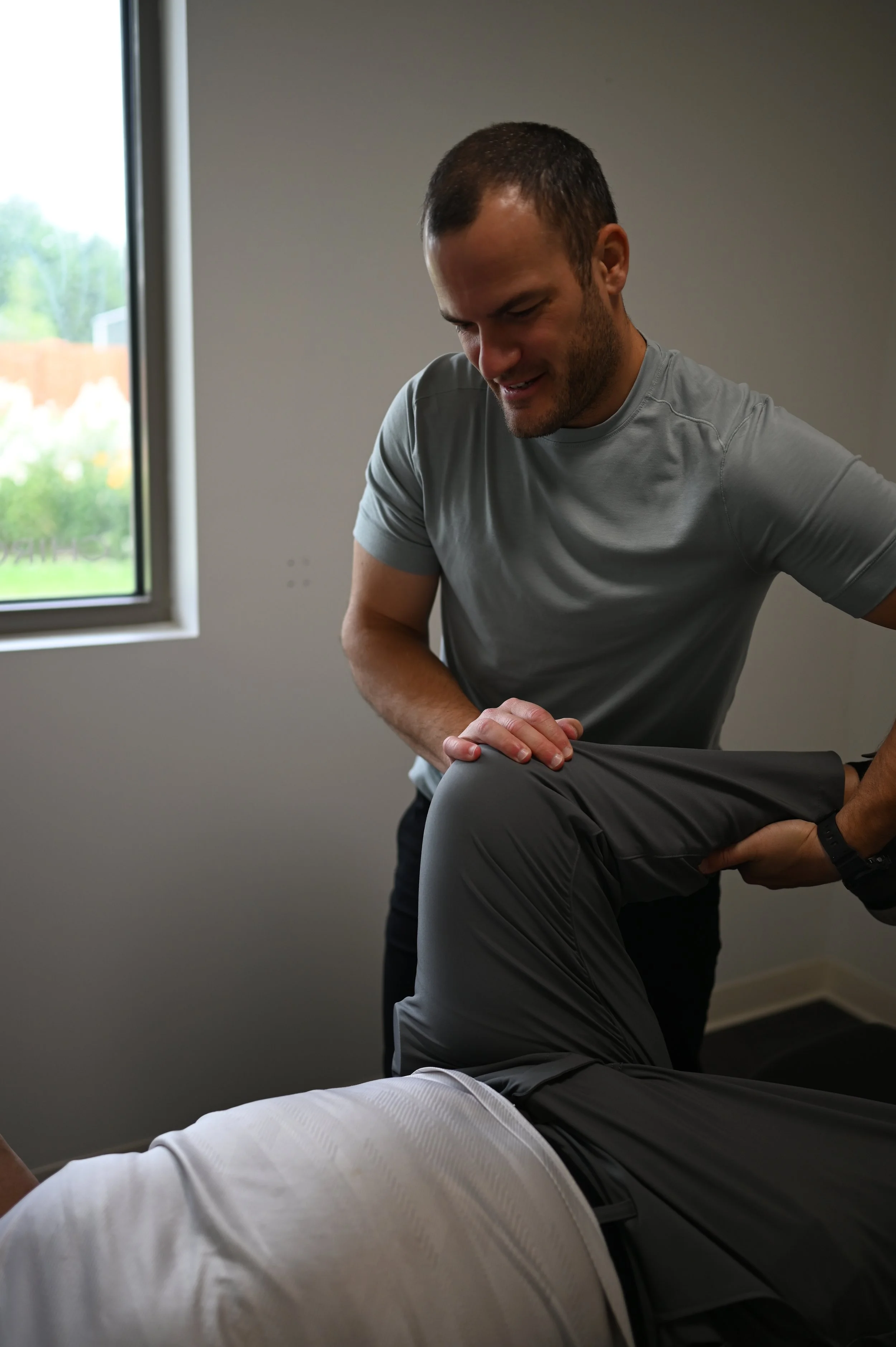
We also adjust the hip joint itself to improve its position within the socket and work on restoring internal rotation where it's limited.
Soft Tissue Work for the Hip Capsule and Flexors
Tight hip flexors and a restricted posterior hip capsule are almost always part of the picture with hip impingement. We use IASTM, cupping, and dry needling to address those tissue restrictions whatever your body needs to restore proper mobility around the joint.
Exercises That Make the Changes Stick
We give you specific exercises to maintain what we work on in the office. Hip capsule mobility work, controlled articular rotations, core stability training that supports pelvic positioning. The goal is to teach your body to move in a way that doesn't create impingement so the results last beyond your appointments.
What You Can Do Starting Today
These won't replace addressing the underlying pattern, but they can help manage symptoms while you're working on the root cause:
Work on hip internal rotation. Lie on your back with your knee bent and foot flat on the floor. Let your knee fall inward and hold for 30 seconds. Most people with hip impingement have limited internal rotation on the affected side.
Improve lumbar spine mobility. Cat-cow stretches and gentle lumbar rotations help your low back move so your hip doesn't have to compensate.
Stretch your hip flexors the right way. Kneel on one knee, other foot forward. Tuck your pelvis under first then lean forward. That posterior pelvic tilt is what actually targets the hip flexors. Without it, you're mostly just leaning forward.
Work on posterior hip capsule mobility. Lie on your back and pull your knee toward your opposite shoulder. This stretches the back of the hip capsule, which is frequently restricted in people with impingement.
Take standing breaks. If you sit all day, set a reminder to stand up every 30-60 minutes and do some hip circles or a quick hip flexor stretch. Don't let your hip stay in flexion for hours on end.
Modify squat depth temporarily. If deep squats cause the pinch, squat to a box at a height that doesn't hurt. As your mechanics improve, you can gradually lower it. The goal is to keep moving just smarter.
Check your pelvic position. If you have a pronounced forward tilt in your pelvis, try gently tucking your tailbone under before you squat. For some people, this alone reduces impingement symptoms immediately.
Frequently Asked Questions About Hip Impingement
Can a chiropractor help hip impingement near Madison, WI?
Yes but it depends on the approach. Chiropractic care that addresses the entire kinetic chain (pelvis, lumbar spine, hip joint mechanics, soft tissue) is very effective for hip impingement. An approach that only focuses on the hip in isolation is less likely to resolve it long-term.
How long does it take to fix hip impingement?
It depends on how long the pattern has been developing and how much structural adaptation has occurred. Most people notice meaningful improvement within several weeks of consistent care. Full resolution of the underlying pattern typically takes longer, and maintaining it requires ongoing attention to movement habits.
Should I stop squatting if I have hip impingement?
Not necessarily. Temporarily modifying depth and load while you address the root cause is usually smarter than stopping completely. Complete rest doesn't fix the mechanical problem it just reduces the load on it. We'll help you figure out what modifications make sense for you.
What if I've had hip impingement for years?
Long-standing patterns take longer to change, but they do change. The longer it's been present, the more important comprehensive assessment becomes because the compensations have had more time to layer on top of each other.
You're Asking the Right Questions
If you read this far, you already know the difference between looking for a real answer and just hoping the pain goes away. That matters. Hip impingement doesn't have to mean giving up your squats, dreading getting in and out of your car, or modifying around every movement you should be able to do freely.
The pinch you feel is information your body telling you something in the chain isn't moving the way it's supposed to. Let's figure out exactly what that is.
Book a comprehensive assessment at Balanced Chiropractic + Wellness in Windsor, WI. We'll look at the whole picture, explain what we find, and give you a clear path forward without telling you to just stop doing what you love.