Why Your IT Band Still Hurts (And What Dane County, Wi Runners Need to Know)
Can chiropractic help with your IT band pain?
Absolutely. But first, we need to understand what's actually causing the pain. Foam rolling your IT band until you cry might feel like you're doing something, but if it's not addressing why your IT band is getting irritated in the first place. So you're going to keep dealing with that pain on the outside of your knee.
And if you're trying to keep up your regular runs around Firemen's Park or along the Token Creek Trail, that nagging pain isn't just annoying. It's threatening your ability to do what you love.
The Pain That's Cutting Your Runs Short
You know the feeling. You're three miles into your run—maybe on the trails at Prairie Moraine Park, maybe your usual loop through Windsor—and that familiar sharp pain starts on the outside of your knee. At first, you try to push through. But with each step, it gets worse. By the time you're heading back, you're limping.
You've tried foam rolling. You've stretched. You've rested for a week or two. But the moment you get back out there, the pain returns. And now you're wondering if you need to give up running altogether.
Here's the good news: you don't. But we do need to figure out what's actually going on.
What Is IT Band Syndrome, Really?
IT band syndrome—or iliotibial band syndrome—is pain on the outside of your knee or hip caused by irritation of the IT band. The IT band is a thick piece of connective tissue that runs from your hip down the outside of your thigh to your knee. When it gets irritated, you feel it.
The Symptoms You're Dealing With
You might notice:
Sharp or burning pain on the outside of your knee that shows up during runs, especially on hills or stairs. Maybe it starts a few miles in and gets progressively worse, or maybe it hits you right away. You might feel it when you bend your knee, or notice tenderness on the outside of your hip in addition to your knee.
Some people hear clicking or popping at the knee. Others just feel tightness along the outside of their thigh that never seems to release no matter how much they stretch or roll.
The really frustrating part? The pain often eases up with rest but comes roaring back as soon as you start running again.
Sound familiar?
Why Foam Rolling Your IT Band Isn't Working
Here's where most treatment approaches miss the mark.
Everyone focuses on the IT band itself. You've been told to foam roll it, stretch it, maybe get a massage. Your physical therapist might have you doing IT band stretches religiously. Maybe you've even invested in one of those aggressive massage tools specifically for your IT band.
Here's the problem with that approach: your IT band is connective tissue, not muscle. You can't actually stretch it. And rolling it aggressively? That's just beating up tissue that's already irritated.
But this begs the question, why is your IT band getting irritated in the first place?
Here's What's Actually Happening
IT band syndrome doesn't just randomly happen. It happens because your IT band is getting pulled too tight or is rubbing excessively over the outside of your knee. Something about how you're moving is creating that excessive tension or friction.
The IT band itself isn't the problem. It's the victim of what's happening upstream at your hip and pelvis.
The Real Causes Behind Your IT Band Pain
Let's talk about what's actually creating the problem.
Your Hip Isn't Stable (The Big One)
This is the most common culprit we see with runners.
When your hip doesn't stabilize properly when you run, almost always because your glutes aren't firing well, your femur (thigh bone) rotates inward with every step. That internal rotation increases tension on your IT band.
Step after step, mile after mile around Windsor Lake or through the DeForest trails, your IT band gets pulled tighter and tighter until it starts rubbing painfully over the bony prominence on the outside of your knee.
Think of it like this: if the foundation of a building shifts, everything above it has to compensate. Your hip is the foundation for your leg. When it's not stable, your knee and IT band pay the price.
Your TFL Is Overworking
The tensor fasciae latae (TFL) is a small muscle on the outside of your hip that connects into your IT band. When your glutes aren't doing their job of stabilizing your hip, your TFL picks up the slack.
It works overtime, gets tight, and pulls on your IT band constantly. That constant tension irritates the IT band where it crosses your knee.
Your TFL wasn't designed to be the primary hip stabilizer. But when your glutes check out, often from too much sitting during the workday, your TFL has no choice but to take over.
Your Pelvis Is Out of Alignment
If your pelvis isn't in proper alignment, it changes the length and tension of your IT band. One side might be pulled tighter than the other. That asymmetry creates problems when you're asking your body to run mile after mile.
Maybe you've noticed your IT band pain is only on one side. That's often a clue that pelvic alignment is playing a role.
Running Surface Issues on Local Routes
If you always run on the same side of the road, which has a slight camber for drainage, or you always run the same direction around the track at DeForest High School, one leg is consistently dealing with an uneven surface.
That creates asymmetric forces through your hip and knee. Over time, your IT band takes the hit.
Even subtle banking on the shoulder of roads around Windsor can create enough asymmetry to irritate an IT band that's already under tension from weak glutes or pelvic misalignment.
You Ramped Up Mileage Too Fast
Maybe you got excited about spring running and jumped from three miles to six miles too quickly. Maybe you added hill repeats when you weren't used to them. Maybe you switched from treadmill to outdoor running on the trails.
Your cardiovascular system could handle the increase. Your lungs were fine. But your hip stabilizers, specifically your glutes, weren't prepared for the increased demand. Your IT band is where the weakness showed up.
Foot Mechanics Are Contributing
If your foot pronates excessively or doesn't push off efficiently, it affects how forces travel up your leg. Those abnormal forces can increase the stress on your IT band.
This is especially common in runners who've recently changed shoes or running surfaces without giving their body time to adapt.
Why This Pattern Developed in the First Place
Often, it's a combination of factors that built up over time.
Maybe you sit at a desk all day, like so many people working from home in Windsor or commuting into Madison. Your hip flexors get tight. Your glutes get weak and stop firing properly. When you go out for a run, your hips don't stabilize like they should. Your TFL and IT band pick up the slack. Eventually, they break down.
Maybe you had an old hip, knee, or ankle injury that you thought healed fine. Your body compensated around it. Those compensations worked okay for walking around and light activity. But now that you're running more, or running differently on the trails, those old compensations are catching up to you.
Maybe you got excited about running and ramped up your mileage too aggressively to train for a local 5K. Your cardiovascular system could handle it. But your hip stabilizers weren't strong enough for the load. Your IT band paid the price.
Or maybe you've always had one leg slightly longer than the other, or your pelvis has always been slightly rotated. Your body compensated fine for years. But now you're asking more of it, and those old asymmetries are causing problems.
Your body is incredibly adaptable. It compensated for the demands you placed on it. But now those adaptations, or the sudden increase in demands, are causing problems.
How We Address IT Band Syndrome at Balanced Chiropractic + Wellness
You were made to move, and move well. That includes running the trails around Windsor and DeForest without IT band pain.

We help by addressing the whole system, not just the tight band on the outside of your leg.
Our Comprehensive Assessment Approach
When someone comes to us with IT band syndrome, we assess their entire lower body and pelvis. We look at hip stability and glute function. Pelvic alignment. TFL tension. Knee mechanics. Foot and ankle function. How everything works together when you move.
We're looking for why your IT band is getting overloaded. Because the IT band itself isn't the problem. It's the victim of what's happening upstream.
We use specialized equipment to objectively measure how you're loading each leg. We can see exactly where the asymmetries are and how your body is compensating. This gives us concrete data instead of just guessing.
Chiropractic Adjustments for Alignment
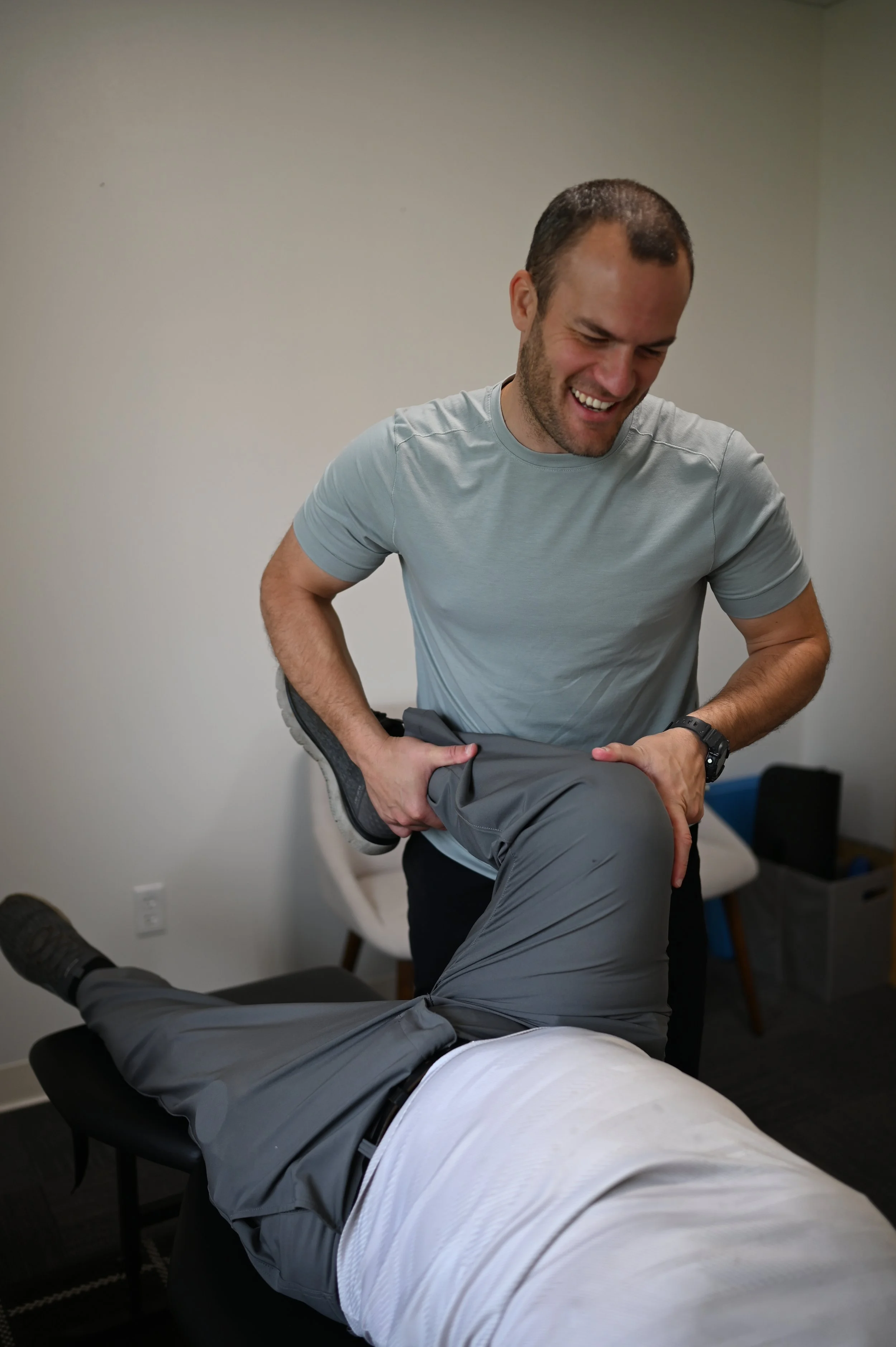
Through specific chiropractic adjustments, we restore proper alignment to your pelvis, hip, and knee.
When your pelvis is aligned properly, the tension on your IT band normalizes. When your hip joint is moving properly, your glutes can do their job of stabilizing instead of your TFL and IT band taking over.
These aren't the aggressive, twisting adjustments you might be imagining. We use precise, targeted adjustments that restore movement to joints that aren't functioning properly.
Soft Tissue Work That Actually Helps
We use soft tissue work to release the tight TFL and address the muscles around your hip. IASTM (instrument-assisted soft tissue mobilization), cupping, dry needling, whatever your body needs.
But we're not just beating up your IT band with a foam roller. We're addressing the muscles that are pulling on it, the ones that are actually tight and overworking.
Movement Retraining and Glute Activation
We give you specific exercises to retrain your glutes to fire properly. Hip stability drills. Single-leg exercises. Glute activation work that teaches your body to stabilize your hip the way it's supposed to.
We also help you understand how to modify your training. How to structure your mileage progression so you're not overwhelming your system. Varying your running surfaces and directions. Footwear considerations. Cross-training options that keep you active without aggravating your IT band.
The goal isn't to keep you out of running, it's to get you back to it sustainably.
What You Can Do Starting Today
Aside from the comprehensive work we do in the office, there are things you can start doing right now to help your IT band.
Stop Aggressively Foam Rolling Your IT Band
Seriously. You're just irritating already-irritated tissue.
If you want to foam roll something, roll your TFL at the top of your outer hip. Roll your quads. Roll your glutes. But go easy on the IT band itself. Light pressure is fine, but stop beating it up.
Activate Your Glutes Before Every Run
Do 15-20 glute bridges and some clamshells before you start running—whether you're heading to Firemen's Park or out to the Token Creek Trail.
Your glutes need to be firing from step one, or your TFL and IT band will take over immediately. Think of it as waking up the muscles you need before asking them to do work.
Work on Hip Stability Exercises
Single-leg deadlifts. Single-leg squats. Side-lying leg lifts with good form, not just flopping your leg up and down.
These strengthen the muscles that should be stabilizing your hip so your IT band doesn't have to. Start light. Focus on control and balance before adding weight.
Modify Your Training Temporarily
If your IT band is already angry, continuing to run the same volume is just going to make it worse.
Cut your mileage by 30-50% while you address the underlying issues. Cross-train with swimming or biking to maintain your cardiovascular fitness without the repetitive impact.
This isn't forever. It's strategic. You're giving your body a chance to heal while you fix the pattern that caused the problem.
Vary Your Running Routes in Windsor and DeForest
If you always run the same route in the same direction, like always running clockwise around Windsor Lake or always running the same side of the road, switch it up.
Run on both sides of the road. Change directions on your regular routes. Mix up flat runs with gentle hills. This reduces the asymmetric forces on your IT band.
Check Your Running Form
If you can, have someone video you running from behind. Is your knee caving inward when your foot hits the ground? Is your hip dropping on one side?
These are signs your hip isn't stabilizing properly, which is probably why your IT band hurts in the first place.
Ice After Activity If It's Acutely Inflamed
If the outside of your knee is hot and swollen after you run, ice can help reduce inflammation in the short term.
But if this has been going on for weeks, inflammation isn't your main problem, hip stability is. Ice might make you feel temporarily better, but it won't fix the underlying issue.
How Long Until I Can Run Pain-Free?
This is one of the most common questions we get, and the honest answer is: it depends.
If we catch it early and you're consistent with the exercises and adjustments, many people notice significant improvement within 2-4 weeks. They can start gradually returning to running with modifications.
If it's been going on for months and you've developed significant compensations, it might take 6-8 weeks of consistent work to fully resolve.
The timeline depends on:
How long you've been dealing with it
How consistent you are with exercises
Whether you're willing to modify your training temporarily
How well your body responds to adjustments
But here's what we can tell you: most people see improvement in pain levels and running tolerance within the first 2-3 visits when we're addressing the actual cause.
Get Back to Running the Trails You Love
You should remember that you're doing enough. If you read this blog to the end, you care about understanding the real cause instead of just rolling your IT band until you bruise. That tells us you're the kind of person who wants to fix the problem, not just mask symptoms.
IT band syndrome doesn't have to end your running season or keep you off the trails you love. If pain on the outside of your knee is cutting your runs short, keeping you off the Firemen's Park trails, or making you dread every downhill, it's time to look at the bigger picture.
Your Next Steps
Ready to figure out why your IT band keeps flaring up?
Book a comprehensive assessment at Balanced Chiropractic + Wellness in Windsor. Let's identify exactly why your hip isn't stabilizing properly and address it at the root cause, so you can get back to running the local trails without that nagging pain on the outside of your knee.
We're located at 6729 Lake Rd Suite 3 in Windsor, right off Highway 51, serving runners and active adults throughout Windsor, DeForest, and the greater Madison area.
Let's get you back to doing what you love.
About the Author Dr. Jeremy Quick is a chiropractor and owner of Balanced Chiropractic + Wellness in Windsor, Wisconsin. He specializes in helping active adults address the root causes of pain so they can return to the activities they love, without being told to "just stop." His approach combines comprehensive movement assessment, chiropractic adjustments, and functional rehabilitation to create lasting results.